



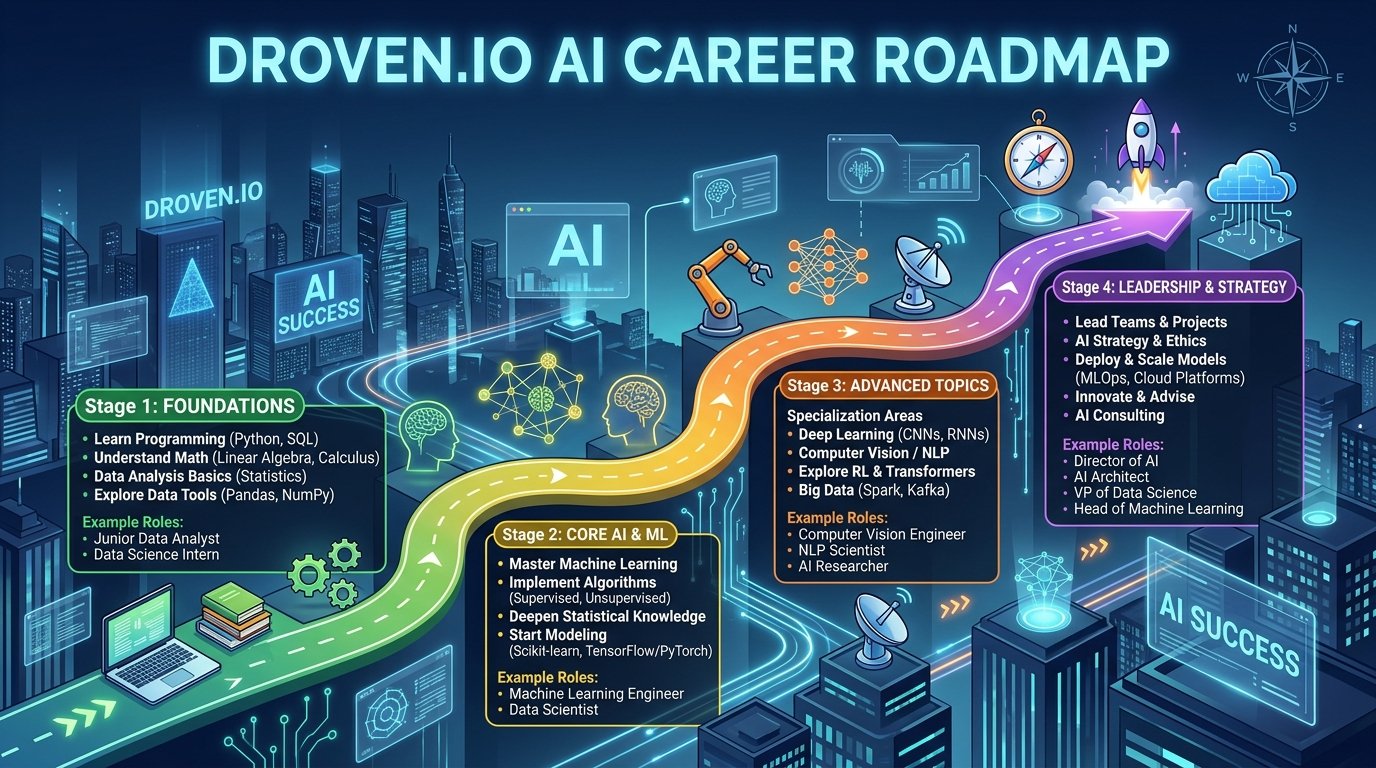
Artificial intelligence is changing the global job market faster than most industries expected. From startups to multinational companies, organizations now rely on AI-driven systems to improve efficiency, automate operations, and create smarter digital experiences. Because of this rapid transformation, professionals are searching for structured ways to enter the AI field and build long-term careers. One topic gaining attention among learners and tech enthusiasts is the droven.io ai career roadmap. It provides a practical direction for people who want to understand AI careers, required skills, learning stages, and industry expectations.
The demand for AI specialists continues to rise across industries such as healthcare, finance, marketing, cybersecurity, education, and software development. However, many beginners feel overwhelmed because AI includes multiple disciplines like machine learning, data science, neural networks, natural language processing, and automation. A well-structured learning path helps remove confusion and creates clarity. That is why the droven.io ai career roadmap has become an important concept for aspiring professionals who want a focused strategy instead of random learning.
Understanding the Purpose of an AI Career Roadmap
An AI career roadmap acts as a guide that outlines the journey from beginner-level understanding to advanced professional expertise. Instead of learning unrelated topics, learners follow a sequence that develops foundational knowledge first and then gradually introduces complex concepts.
The modern technology industry values practical skills more than memorized theory. Employers want professionals who can solve real problems using AI tools and techniques. A roadmap helps learners prioritize what matters most and avoid wasting time on outdated methods or unnecessary subjects.
The droven.io ai career roadmap is useful because it emphasizes structured growth. Rather than jumping directly into machine learning algorithms without understanding programming or mathematics, learners progress step by step. This reduces frustration and improves long-term retention.
Why AI Careers Are Growing Rapidly
Artificial intelligence is no longer limited to research laboratories. Businesses use AI in customer support systems, recommendation engines, fraud detection, medical diagnostics, and predictive analytics. This widespread adoption has created thousands of new job opportunities worldwide.
Several factors contribute to the rapid expansion of AI careers:
Increased Automation
Companies aim to automate repetitive tasks to save time and reduce operational costs. AI systems now handle data analysis, customer interactions, and workflow management more efficiently than traditional methods.
Demand for Data-Driven Decisions
Organizations collect enormous amounts of data daily. AI professionals help transform this raw information into valuable insights that improve decision-making and business performance.
Expansion of AI Tools
User-friendly AI platforms allow businesses to integrate intelligent systems without building everything from scratch. This has increased the need for skilled professionals who understand implementation and optimization.
Competitive Technology Market
Companies that fail to adopt AI risk falling behind competitors. As a result, businesses actively recruit AI specialists to strengthen innovation and maintain market relevance.
The droven.io ai career roadmap becomes especially important in this environment because learners need a clear plan to enter a highly competitive industry.
Essential Skills Needed for an AI Career
Anyone pursuing the droven.io ai career roadmap should understand the core skills required in artificial intelligence. These abilities form the foundation of successful AI careers.
Programming Knowledge
Programming is one of the most critical skills in AI development. Python remains the most widely used language because of its simplicity and powerful libraries. Learning Python allows beginners to build machine learning models, automate tasks, and process data efficiently.
Other useful languages include:
- R for statistical analysis
- Java for scalable systems
- C++ for performance-intensive applications
- JavaScript for AI-powered web solutions
Mathematics and Statistics
AI heavily relies on mathematics. Concepts such as linear algebra, probability, calculus, and statistics are essential for understanding how machine learning algorithms function.
Without mathematical knowledge, it becomes difficult to interpret model behavior or optimize performance accurately.
Data Handling
AI systems depend on high-quality data. Professionals must know how to clean, organize, analyze, and visualize datasets before training models.
Data preprocessing skills are extremely valuable because poor data quality leads to inaccurate AI predictions.
Machine Learning Fundamentals
Machine learning forms the backbone of modern AI systems. Learners should understand supervised learning, unsupervised learning, classification, regression, and clustering techniques.
The droven.io ai career roadmap often highlights machine learning as a major milestone because it connects theory with practical implementation.
Problem-Solving Skills
AI professionals regularly face complex challenges. Strong analytical thinking helps identify patterns, optimize algorithms, and improve system performance.
Employers value individuals who can think critically and develop creative solutions.
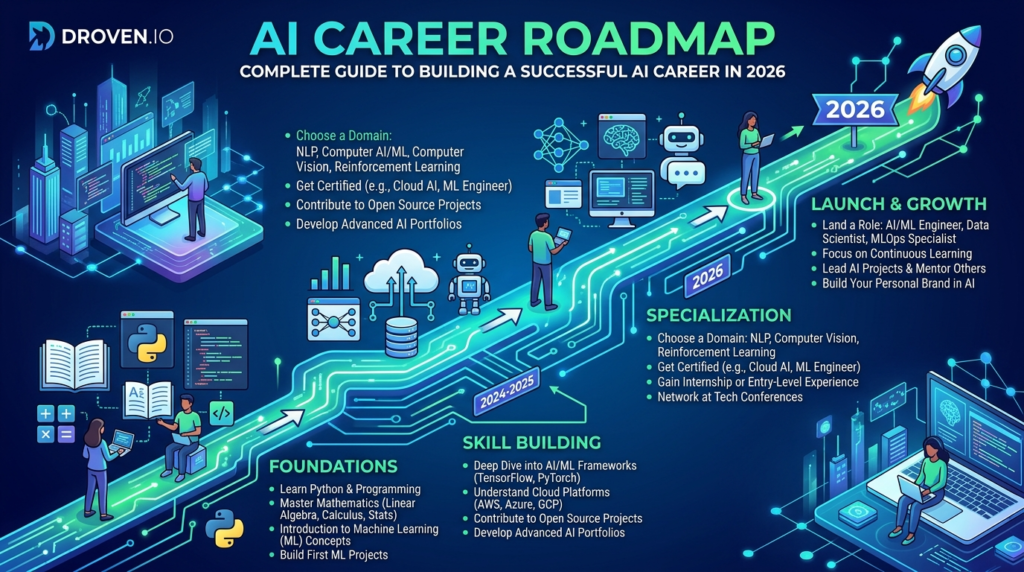
Beginner Stage in the AI Journey
The beginner phase is crucial because it builds the foundation for future specialization. Many people fail in AI because they skip essential basics and move directly to advanced topics.
A beginner following the droven.io ai career roadmap should focus on the following areas first:
Learning Basic Programming
Start with simple coding exercises and gradually progress toward data manipulation and automation projects. Consistency matters more than speed during this stage.
Understanding Core Concepts
Before training advanced models, learners should understand:
- What artificial intelligence means
- Difference between AI and machine learning
- How algorithms process information
- Role of datasets in AI systems
Practicing Small Projects
Small projects improve confidence and practical understanding. Beginners can create:
- Simple chatbots
- Recommendation systems
- Data analysis dashboards
- Image recognition experiments
Practical work strengthens learning more effectively than passive reading.
Intermediate AI Career Development
After mastering the basics, learners enter the intermediate stage. This phase involves deeper technical understanding and real-world application.
The droven.io ai career roadmap often emphasizes specialization during this level because AI contains multiple career paths.
Exploring Machine Learning Models
Intermediate learners study algorithms such as:
- Decision trees
- Random forests
- Support vector machines
- Neural networks
Understanding how these models work helps professionals choose suitable solutions for different problems.
Working With AI Frameworks
AI development frameworks simplify model creation and deployment. Popular frameworks include TensorFlow, PyTorch, and Scikit-learn.
Hands-on experience with these tools increases employability significantly.
Building Portfolio Projects
A strong portfolio demonstrates practical capability. Employers often prefer candidates with proven project experience rather than only certifications.
Good portfolio ideas include:
- AI-powered web applications
- Sentiment analysis systems
- Predictive analytics tools
- Fraud detection models
The droven.io ai career roadmap encourages project-based learning because it reflects real industry expectations.
Advanced AI Expertise and Specialization
At the advanced stage, professionals usually focus on specific AI domains. Specialization allows deeper expertise and higher earning potential.
Natural Language Processing
Natural language processing focuses on enabling machines to understand human language. It powers chatbots, virtual assistants, translation systems, and text analysis tools.
Computer Vision
Computer vision involves image and video recognition technologies. Industries use it for facial recognition, medical imaging, surveillance, and autonomous vehicles.
Deep Learning
Deep learning uses neural networks to process complex data patterns. It is widely used in speech recognition, image generation, and advanced prediction systems.
Robotics and Automation
AI-driven robotics improves manufacturing, logistics, and healthcare operations. Professionals in this field combine software intelligence with physical automation systems.
The droven.io ai career roadmap supports specialization because advanced expertise often leads to leadership opportunities and research positions.
Importance of Real-World Experience
One major mistake learners make is relying entirely on theory. Real-world application is essential in AI because practical environments introduce challenges that textbooks cannot fully explain.
Internships and Freelance Work
Internships provide exposure to real business problems. Freelance projects also help professionals gain hands-on experience while building client relationships.
Open-Source Contributions
Contributing to open-source AI projects helps learners collaborate with experienced developers and improve coding standards.
Competitions and Challenges
AI competitions encourage problem-solving under realistic conditions. These events improve technical confidence and strengthen resumes.
The droven.io ai career roadmap highlights experience because employers prioritize individuals who can deliver practical results.
Common Challenges in AI Learning
Artificial intelligence is rewarding, but the learning process can be difficult. Understanding common obstacles helps learners stay prepared.
Information Overload
There are countless tutorials, courses, and resources online. Beginners often feel confused about where to start.
A roadmap solves this problem by creating a clear direction.
Rapid Technological Changes
AI evolves quickly. New frameworks and models appear regularly, making continuous learning necessary.
Complex Mathematics
Many learners struggle with advanced mathematics. Breaking concepts into smaller lessons helps reduce difficulty.
Lack of Consistency
Consistency is one of the biggest success factors in AI careers. Daily practice creates stronger long-term understanding than occasional intensive study sessions.
The droven.io ai career roadmap helps learners maintain focus despite these challenges.
Career Opportunities in Artificial Intelligence
Artificial intelligence offers diverse career options for professionals with different interests and skill sets.
Machine Learning Engineer
Machine learning engineers design and deploy intelligent models for business applications.
Data Scientist
Data scientists analyze information to generate insights and predictions.
AI Research Scientist
Research scientists explore advanced AI concepts and develop innovative algorithms.
Computer Vision Engineer
These professionals build systems that interpret images and videos.
NLP Engineer
NLP engineers focus on language-based AI systems such as chatbots and voice assistants.
AI Product Manager
Product managers coordinate AI project development while balancing business and technical goals.
The droven.io ai career roadmap helps learners identify which path aligns with their strengths and interests.
Soft Skills That Matter in AI Careers
Technical knowledge alone is not enough. Employers also value communication, collaboration, and adaptability.
Communication Skills
AI professionals must explain technical concepts to non-technical teams and stakeholders.
Team Collaboration
Most AI projects involve collaboration between developers, analysts, managers, and designers.
Adaptability
Technology changes rapidly, so professionals must remain flexible and open to learning.
Time Management
AI projects often involve strict deadlines and large datasets. Effective time management improves productivity and project success.
The droven.io ai career roadmap supports balanced growth by emphasizing both technical and professional development.
How to Stay Updated in the AI Industry
Continuous learning is essential in artificial intelligence because innovation never stops.
Read Industry Updates
Following technology trends helps professionals stay informed about emerging tools and research.
Practice Regularly
Skills weaken without practice. Building projects regularly keeps knowledge sharp.
Join Professional Communities
Networking with other AI learners and professionals creates opportunities for mentorship and collaboration.
Experiment With New Tools
Trying new frameworks and technologies improves adaptability and technical versatility.
The droven.io ai career roadmap encourages lifelong learning because AI careers require ongoing improvement.
Building a Long-Term AI Career Strategy
Success in AI rarely happens overnight. Sustainable career growth requires patience, consistency, and strategic planning.
Set Clear Goals
Define short-term and long-term objectives. Knowing the desired career path improves focus.
Avoid Comparing Progress
Every learner advances at a different pace. Comparing yourself to others can reduce motivation unnecessarily.
Focus on Practical Value
Employers care about results. Building useful solutions creates stronger professional credibility.
Maintain Curiosity
Curiosity drives innovation. The most successful AI professionals continuously explore new ideas and technologies.
The droven.io ai career roadmap serves as a structured foundation for long-term professional growth in a rapidly evolving industry.
The Future of AI Careers
Artificial intelligence will continue influencing nearly every major industry. As automation expands, businesses will increasingly rely on AI specialists to create intelligent solutions and maintain competitive advantages.
Future AI careers may include roles that do not even exist today. Technologies like generative AI, autonomous systems, and advanced robotics will create entirely new professional opportunities.
People who start learning now gain a significant advantage because early experience becomes highly valuable over time. The ability to adapt and continuously improve will determine long-term success in this field.
The droven.io ai career roadmap represents more than just a learning guide. It symbolizes a structured approach toward building expertise, confidence, and career stability in one of the world’s fastest-growing industries.
Conclusion
Artificial intelligence offers enormous opportunities for learners willing to invest time and effort into skill development. However, success requires more than random tutorials or scattered learning. A clear structure helps learners progress efficiently from beginner-level understanding to advanced specialization.
The droven.io ai career roadmap provides direction for individuals seeking practical growth in AI careers. By focusing on programming, mathematics, machine learning, real-world projects, and continuous learning, aspiring professionals can build strong foundations and remain competitive in the evolving technology landscape.
AI is not just a trend. It is becoming a permanent part of modern business and innovation. Those who commit to learning today may become the industry leaders of tomorrow.